
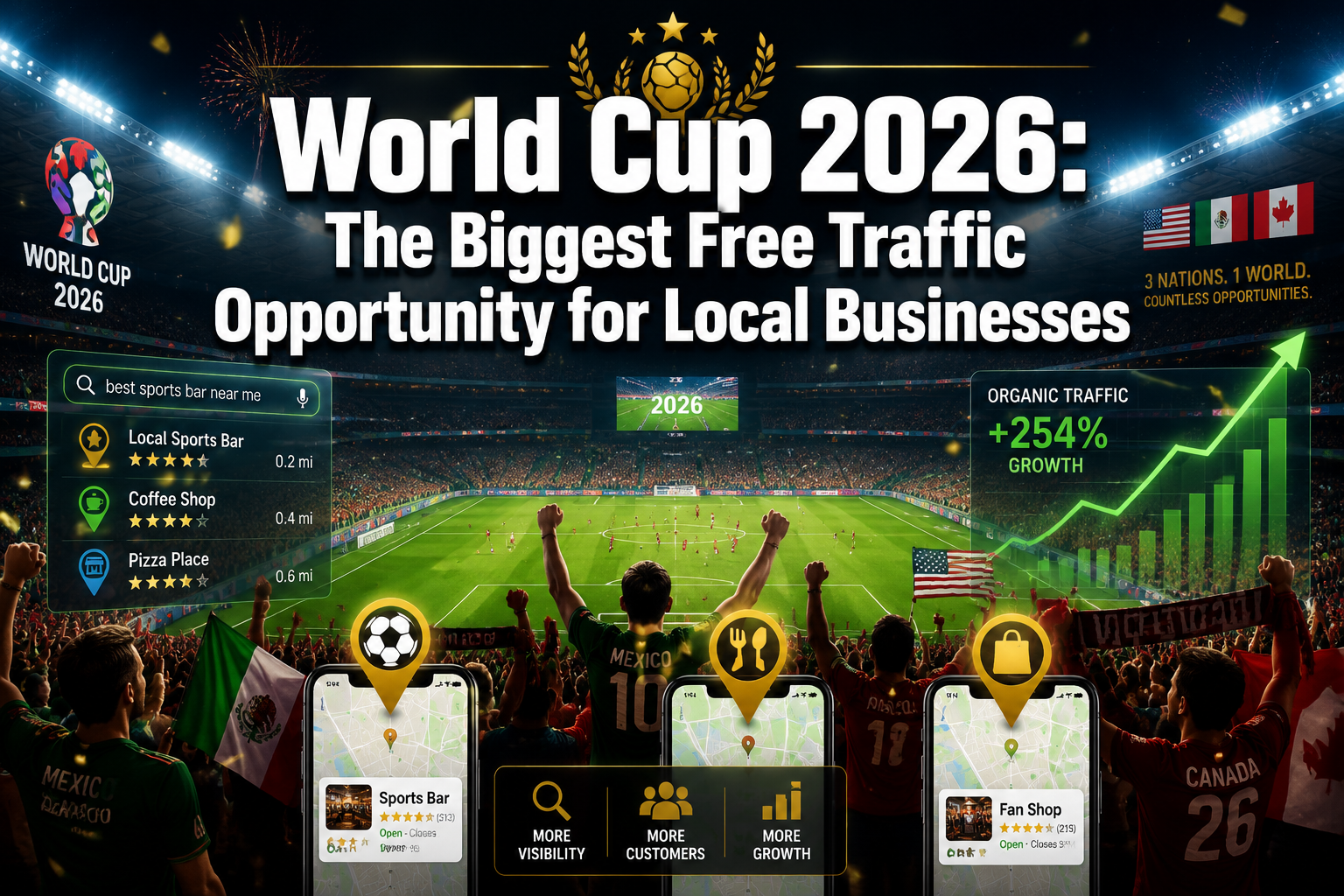
World Cup 2026 represents the largest concentrated traffic opportunity for local businesses in four years, with millions of tourists visiting North America and billions of event-related searches happening across Google, social media, and maps platforms. Local businesses can capture this free, high-intent traffic by creating location-specific World Cup content, updating their online profiles, and positioning themselves for event-related searches months before the tournament begins.
Key Takeaways
• Massive search volume spike: World Cup 2026 will generate millions of location-based searches like “World Cup watch party [city]” and “sports bars near me”
• North American hosting advantage: With matches across the US, Canada, and Mexico, even non-host cities benefit from increased tourism and watch party demand
• Free traffic opportunity: This is intent-driven discovery traffic, not paid advertising—people actively searching for local experiences
• Timing is critical: Traffic is captured before the event starts through strategic content creation and profile optimization
• Multi-platform reach: Opportunities span Google, Bing, Pinterest, TikTok, Instagram, and Maps platforms
• Simple execution: Basic local SEO and World Cup-themed content can capture thousands of high-intent visitors
• Revenue conversion: Event-based promotions and themed experiences turn traffic into immediate sales and long-term customers
• Four-year cycle: This concentrated opportunity only happens once every four years, making preparation essential
Every four years, the world stops to watch soccer. But here’s what most local business owners don’t realize: World Cup 2026 isn’t just a sporting event—it’s the biggest free traffic goldmine your business will see until 2030.
While your competitors are posting random social media content and hoping for the best, smart business owners are positioning themselves to capture millions of high-intent searches from tourists, locals planning watch parties, and fans looking for the perfect place to experience the tournament. The businesses that understand how to get customers during this global event will see traffic spikes that dwarf their typical marketing efforts.
Most small businesses will completely miss this once-every-four-years opportunity because they’re not thinking about it yet. But the traffic gets captured before the crowds show up, not after.
Why World Cup 2026 Is a Local Business Goldmine
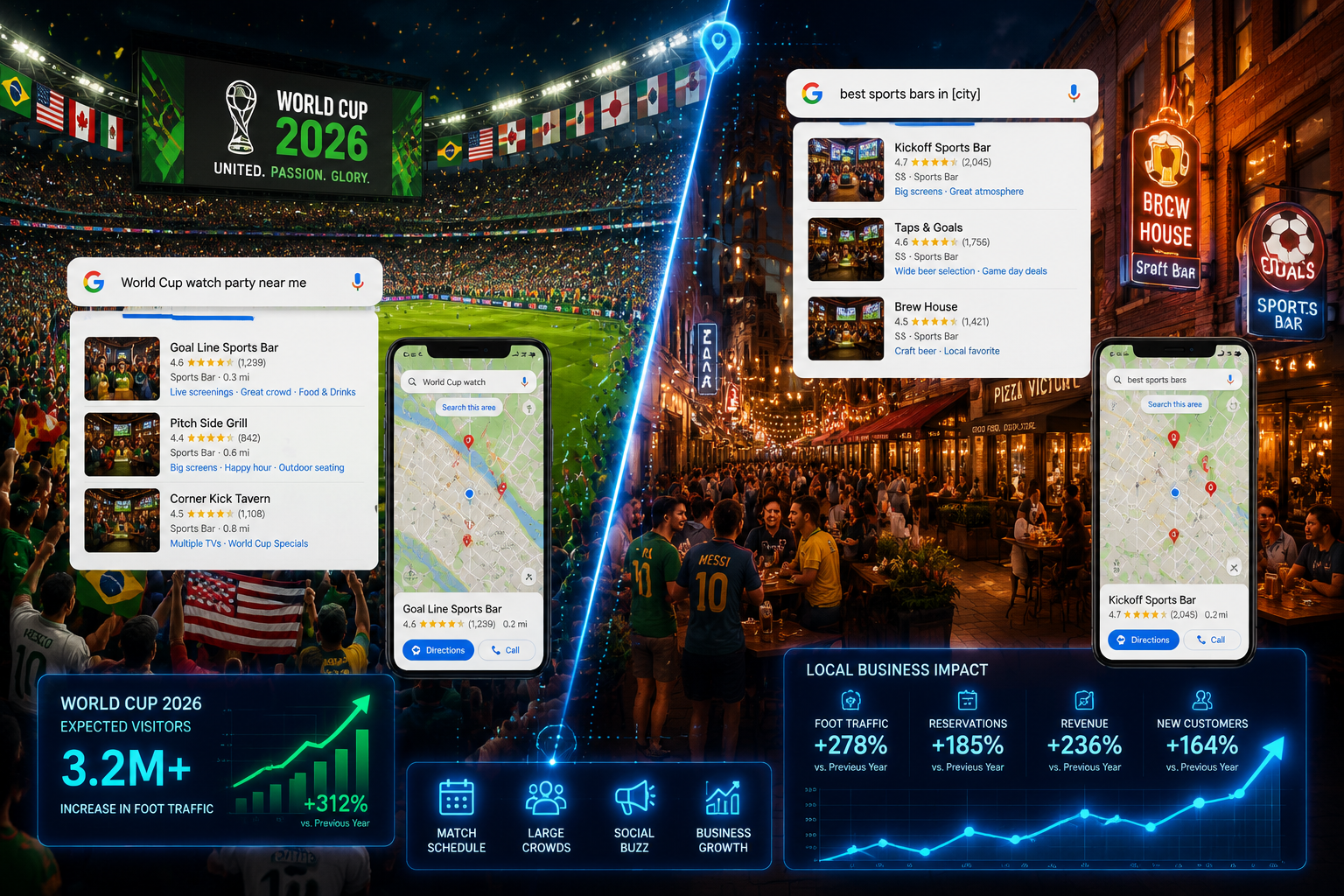
World Cup 2026 creates the perfect storm for local business traffic because it’s the first World Cup hosted across North America (United States, Canada, and Mexico) since 1994. This geographic advantage means unprecedented tourism numbers, massive local search volume, and event-based spending that benefits businesses far beyond the host cities.
The tournament drives three distinct traffic surges that smart businesses can capture:
Tourism explosion: Host cities like New York, Los Angeles, Miami, and Toronto will see millions of international visitors who need places to eat, drink, shop, and gather. These tourists rely heavily on mobile search to find local businesses, creating thousands of “near me” searches every day.
Local search surge: Even in non-host cities, searches for “World Cup watch party,” “sports bars showing World Cup,” and “restaurants with big screens” will spike dramatically. Local businesses that position themselves for these searches can capture customers who might never have found them otherwise.
Event-based spending: The World Cup creates a month-long spending spree where people justify purchases they wouldn’t normally make—special dinners, group outings, themed merchandise, and celebratory experiences.
Here’s a concrete example: A local bar in Dallas that creates content around “World Cup watch party Dallas” could capture thousands of searches from both tourists visiting Texas and locals planning group viewing experiences. These aren’t casual browsers—they’re people with credit cards ready, looking for exactly what that business offers.
The key insight most businesses miss is that even small towns benefit from World Cup traffic. When people search for watch party locations, sports bars, or group dining options in their area, they’re showing high purchase intent. The businesses that show up in those search results win customers who are ready to spend money immediately.
Where the Free Traffic Actually Comes From
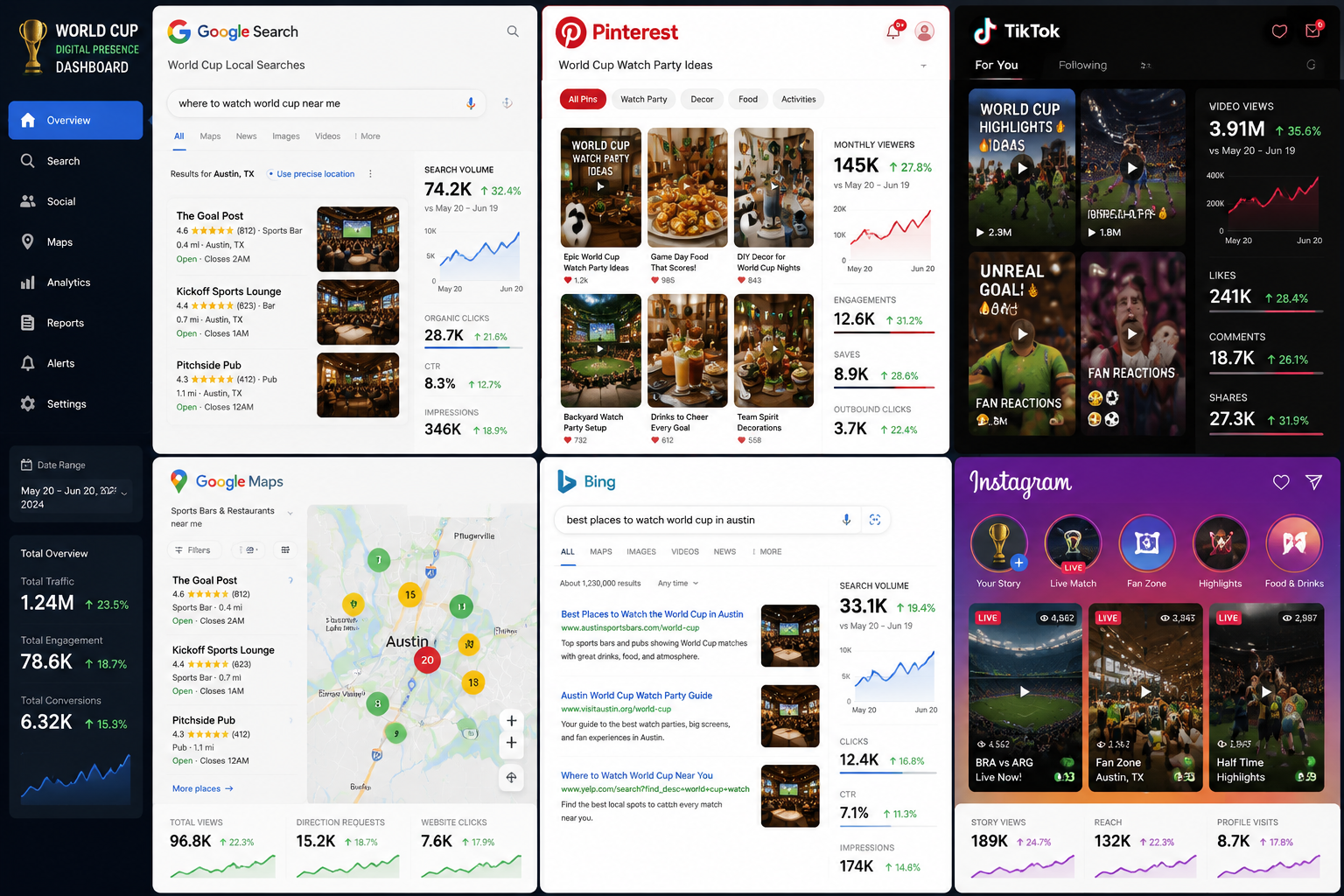
The World Cup traffic opportunity spans multiple platforms where attention and search volume will spike dramatically during 2026. Understanding where people will be searching helps you position your content to get found when it matters most.
Google and Bing local searches will see massive volume increases for location-specific queries. People search for “World Cup viewing near [city],” “sports bars with big screens,” “group dining restaurants,” and “watch party venues.” These searches have immediate commercial intent—people are looking for a place to go right now.
Pinterest becomes a planning powerhouse during major events. Users create boards for “World Cup watch party ideas,” “soccer themed food,” “fan outfit inspiration,” and “sports bar decorations.” Businesses can capture this planning-phase traffic by creating pins that showcase their World Cup experience, special menus, or event spaces.
TikTok and Instagram explode with real-time content during live events. Hashtags like #WorldCup2026, #[YourCity]Soccer, and #WatchParty will trend throughout the tournament. Businesses posting behind-the-scenes content, fan reactions, and live updates can reach audiences far beyond their typical follower base.
Maps platforms (Google Maps, Apple Maps) see concentrated searches for nearby businesses during match times. When someone searches “sports bar” or “restaurant” near their location during a World Cup match, they’re looking for immediate options. Businesses with updated profiles and World Cup-related keywords in their descriptions get priority placement.
The crucial difference between World Cup traffic and regular marketing is intent level. This isn’t random social media scrolling—it’s people actively searching for specific local experiences. They’re not browsing; they’re buying. The businesses that show up in the right places at the right times capture customers who are ready to spend money immediately.
This traffic surge happens whether you’re in a host city or not. Local search volume for sports and entertainment venues increases everywhere during major sporting events because people want to watch with others, not alone at home.
The Biggest Mistake Local Businesses Will Make
Most local businesses will sabotage their World Cup opportunity by making one critical timing error: waiting until the tournament starts to begin their marketing efforts.
The traffic is won before the crowd shows up. By the time World Cup 2026 kicks off in June, search algorithms have already decided which businesses to show for event-related queries. The businesses creating World Cup content in early 2026 will dominate search results when the traffic surge hits.
Here’s what happens when businesses wait too long:
Search engines favor established content: Google and Bing prioritize content that’s been live for months over fresh posts created during the event. A blog post titled “Best World Cup Watch Party Spots in Phoenix” published in March 2026 will outrank the same content published in June.
Competition intensifies: Once the tournament begins, every business realizes the opportunity and starts creating World Cup content simultaneously. The businesses that started early have already captured the top search positions.
Social media algorithms reward consistency: Platforms like TikTok and Instagram boost content from accounts that have been consistently posting about World Cup topics, not accounts that suddenly pivot during the event.
The second major mistake is creating generic content instead of location-specific, searchable content. Posting “Go Team USA!” on Facebook doesn’t capture traffic. Creating a blog post about “Where to Watch World Cup 2026 in [Your City]: Complete Guide to Local Sports Bars and Restaurants” does.
Many businesses also make the platform mistake—focusing only on posting random content on social media instead of creating content that actually gets found through search. Social media posts disappear in hours, but search-optimized content continues driving traffic for months.
The businesses that understand how to get customers during major events start their content creation and profile optimization months in advance, not days before.
Simple Traffic Plays Any Business Can Use
The most effective World Cup marketing strategies are also the simplest to execute. You don’t need a massive budget or complex campaigns—you need strategic content that helps people find your business when they’re actively searching.
Create location-specific World Cup content that targets how people actually search. Instead of generic posts, publish content like:
- “Best Places to Watch World Cup in [Your City]”
- “[Your City] World Cup Watch Party Guide 2026”
- “Sports Bars with Big Screens in [Your Area]”
- “Group Dining Spots for World Cup Viewing in [Your City]”
These titles match exactly how people search when they’re looking for local World Cup experiences.
Update your Google Business Profile and other listings with World Cup-related information. Add keywords like “World Cup viewing,” “sports bar,” “large screens,” or “group events” to your business description. Update your hours if you’ll be open longer during matches. Add photos of your screens, seating areas, and any World Cup decorations.
Publish content across multiple formats to capture traffic from different platforms:
- Blog posts for Google search traffic
- Pinterest pins showcasing your World Cup setup, special menus, or watch party atmosphere
- Short videos for TikTok and Instagram showing your screens, crowd reactions, or behind-the-scenes preparation
- Google My Business posts announcing World Cup specials or viewing events
Target long-tail keywords that combine location, viewing experience, and event details:
- “Sports bars with outdoor seating [city] World Cup”
- “Restaurants showing World Cup matches [neighborhood]”
- “Private event spaces World Cup parties [city]”
- “Family-friendly World Cup viewing [area]”
These longer, more specific phrases have less competition but higher conversion rates because they match exactly what motivated customers are searching for.
The key is consistency and timing. Start creating this content in early 2026, publish regularly, and focus on helping people find exactly what they’re looking for rather than just promoting your business.
For businesses that want a systematic approach to capturing this traffic, the Side Door Traffic System provides a complete framework for identifying and capturing high-intent search traffic from events like the World Cup.
How to Get Customers: Converting World Cup Traffic Into Sales
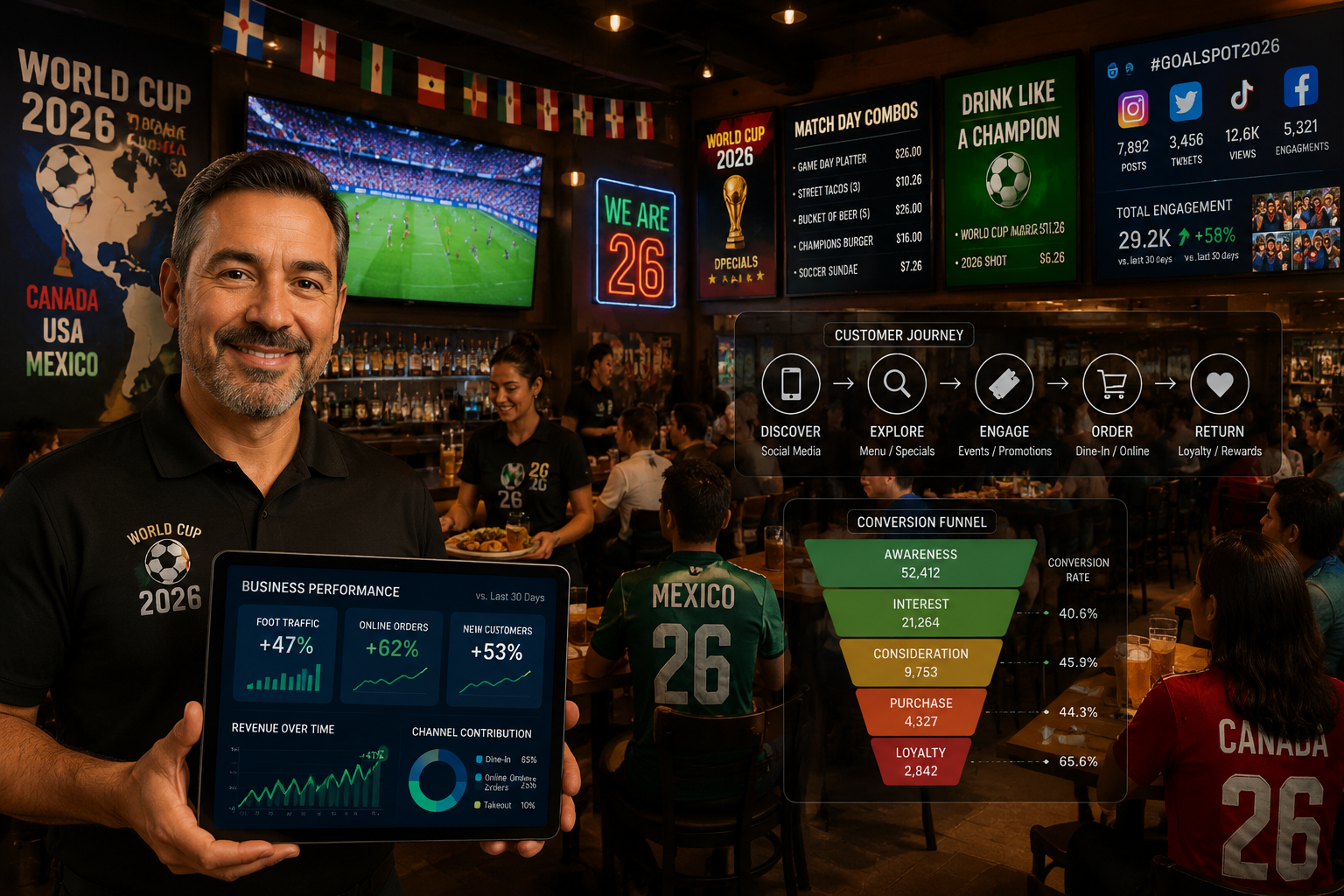
Capturing World Cup traffic is only half the equation—the real profit comes from converting those visitors into paying customers and repeat business. The businesses that thrive during World Cup 2026 will be those that create compelling reasons for people to choose their location and return after the tournament ends.
Offer clear, simple World Cup promotions that visitors can understand immediately. Complex deals confuse people who are making quick decisions about where to watch matches. Effective promotions include:
- “World Cup Special: $5 appetizers during all matches”
- “Buy 2 drinks, get 1 free during World Cup games”
- “World Cup viewing: No cover charge with food purchase”
- “Group of 6+: Free appetizer platter”
The key is making the offer obvious and easy to claim without complicated terms or restrictions.
Create themed experiences that give people reasons to choose your business over competitors. This goes beyond just showing the matches—it’s about creating an atmosphere that enhances the World Cup experience:
- Decorate with flags from World Cup countries
- Create special World Cup menu items or drink specials
- Offer prizes for match predictions or trivia
- Set up photo opportunities with World Cup themes
- Adjust your music and atmosphere to match the international vibe
Capture contact information for future marketing while people are excited and engaged. World Cup visitors represent potential long-term customers, not just one-time sales:
- Offer email signup for “World Cup match reminders and specials”
- Create a text message list for last-minute seating availability
- Run social media contests that require following your accounts
- Collect information through loyalty program signups
Extend operating hours strategically to capture additional revenue during peak match times. Many World Cup matches will happen during non-traditional business hours due to time zone differences. Businesses that adjust their schedules to accommodate match viewing can capture sales that competitors miss.
Partner with neighboring businesses to create World Cup districts or experiences that benefit everyone. When multiple businesses coordinate their World Cup efforts, they create destinations that attract more visitors than any single business could alone. This works especially well in downtown areas or shopping districts.
The most successful businesses use World Cup 2026 as a customer acquisition event, not just a short-term revenue boost. They focus on creating positive experiences that turn World Cup visitors into regular customers long after the tournament ends.
If you need ready-made content to promote these World Cup experiences across social media, the 30 Days Social Media Content Package includes templates specifically designed for event-based marketing that converts browsers into buyers.
Why Most Businesses Still Won’t Capitalize on This Opportunity
Despite the obvious potential of World Cup 2026, most local businesses will fail to capture meaningful traffic from this global event. Understanding why helps you avoid the same mistakes and position your business among the few that actually benefit.
Lack of systematic content strategy is the primary reason businesses miss major traffic opportunities. Most business owners think posting occasionally on social media constitutes marketing, but World Cup traffic requires consistent, searchable content created months in advance. Without a system for identifying keywords, creating content, and publishing consistently, businesses can’t compete for high-intent search traffic.
No framework for consistent traffic generation means businesses approach each opportunity randomly instead of strategically. They might create one World Cup post and expect results, rather than building a comprehensive content approach that captures traffic from multiple platforms and search queries.
Platform overwhelm leads to paralysis instead of action. Business owners see the need to be on Google, Pinterest, TikTok, Instagram, and other platforms, then do nothing because it feels too complicated. The businesses that succeed pick 2-3 platforms and execute consistently rather than trying to be everywhere at once.
Focusing on followers instead of searchers causes businesses to create content for their existing audience rather than content that attracts new customers. World Cup traffic comes from people who don’t know your business exists yet—they’re searching for solutions, not following your social media accounts.
Underestimating the preparation time required means starting too late to capture search algorithm preferences. Most businesses will realize the World Cup opportunity in May or June 2026, but the businesses dominating search results will have started their content creation in January and February.
The businesses that successfully capitalize on World Cup 2026 will be those that treat it as a systematic traffic acquisition project, not a casual marketing opportunity. They’ll have frameworks for creating consistent content, systems for identifying high-value keywords, and processes for converting traffic into customers.
This is exactly why tools like the Side Door Traffic System exist—to give businesses a repeatable framework for capturing traffic from major events and trends, rather than hoping random social media posts will somehow generate customers.
The World Cup happens every four years. The businesses that build systems now will be positioned to capture traffic not just from World Cup 2026, but from every major event and trend that follows.
Conclusion
World Cup 2026 represents a once-every-four-years opportunity for local businesses to capture massive amounts of free, high-intent traffic from tourists, locals planning watch parties, and fans searching for the perfect viewing experience. The businesses that understand how to get customers during this global event will see traffic and revenue spikes that dwarf their typical marketing efforts.
The key insights that separate successful businesses from those that miss this opportunity entirely:
Start early: Traffic is captured before the tournament begins through strategic content creation and profile optimization, not during the event when competition intensifies.
Think like your customers search: Create location-specific content that matches real search queries like “World Cup watch party [your city]” rather than generic social media posts.
Focus on multiple platforms: Capture traffic from Google search, Pinterest planning, TikTok engagement, and Maps searches by publishing consistent, searchable content across platforms.
Convert traffic systematically: Use clear promotions, themed experiences, and contact capture to turn World Cup visitors into long-term customers, not just one-time sales.
Build systems, not campaigns: The businesses that thrive during major events have frameworks for consistent content creation and traffic generation, not random posting strategies.
The most important action you can take right now is to start creating World Cup-related content for your local area. Every month you wait makes it harder to compete for the search positions that will drive the most traffic when the tournament begins.
Ready to Capture World Cup 2026 Traffic Before Your Competitors?
If you want to tap into World Cup 2026 traffic before your competitors even realize what’s happening, you need two things: a traffic system and consistent content that actually gets found.
That’s exactly what the Side Door Traffic System is built for. It shows you how to pull in free, high-intent traffic from platforms most businesses ignore—so you’re not fighting for attention, you’re quietly capturing it.
And if you don’t have time to create daily content around trends like the World Cup, the 30 Days Social Media Content Package gives you plug-and-play posts designed to attract, engage, and convert—without starting from scratch.
Don’t wait until the traffic surge hits. By then, it’s already too late.
Start building your visibility now—and be the business people find first when the world starts searching.
SEO Meta Title: How to Get Customers: World Cup 2026 Free Traffic for Local Business
Meta Description: Discover how World Cup 2026 creates massive free traffic opportunities for local businesses. Learn proven strategies to capture high-intent customers before competitors.
Tags: World Cup 2026 marketing, how to get customers, local business traffic, event marketing, local SEO, sports marketing, customer acquisition, free traffic strategies, World Cup business opportunities, local marketing 2026, tourism marketing, search traffic